You know that moment in history when everything changes? When the way people live, govern themselves, and even think about the world takes an irreversible turn? For much of ancient Mesopotamia and beyond, that moment arrived with the Akkadian Empire and Sargon the Great. This wasn't just another kingdom; it was the birth of the world's first true empire, a revolutionary concept that fundamentally reshaped human civilization and set the stage for all future large-scale political entities.
Before Sargon, the landscape of Mesopotamia was a patchwork of independent city-states, each with its own ruler, gods, and fiercely guarded borders. Sargon didn't just conquer them; he knitted them together into a unified, centrally managed super-state, proving that a vast, diverse territory could indeed operate under a single banner. It was a feat of ambition, military genius, and administrative innovation that still resonates thousands of years later.
At a Glance: Sargon the Great & The Akkadian Empire
- Who was Sargon the Great? The founder and first emperor of the Akkadian Empire, reigning from 2334 to 2279 B.C.
- What was his biggest achievement? Creating the world's first empire by unifying independent Akkadian and Sumerian city-states across Mesopotamia and beyond.
- Where was the empire located? Centered in Mesopotamia, it expanded into Syria, Anatolia, Elam, and other vast territories.
- What made his empire revolutionary? Centralized government, standardized administration (language, weights, measures), innovative military tactics, and infrastructure development.
- What was his capital? Akkad, a city he built on the Euphrates, becoming a major trade hub.
- What's his legacy? A model for future empires (Babylonian, Assyrian), advancements in art and religion, and a legendary figure whose story inspired rulers for millennia.
The Man, The Myth, The Monarch: Sargon's Unlikely Ascent
Sargon's early life reads like a myth, a classic "zero to hero" tale. Born of Semitic origin, the legends say he started as a cupbearer to Ur-Zababa, the King of Kish. This seemingly humble position was often a stepping stone, placing individuals close to power and giving them insights into court politics. His rise wasn't simply a matter of seizing opportunity; it involved navigating treacherous alliances and outright betrayals, including a dramatic falling out with Lugalzagesi of Umma, a king with whom he initially allied to conquer Kish.
This legendary beginning underscores a crucial point about Sargon: he wasn't born into absolute power, nor did he inherit it. He forged it through sheer will, strategic brilliance, and perhaps, a healthy dose of ruthlessness. His story, embellished over centuries, served as a powerful narrative for aspiring rulers, emphasizing destiny, cunning, and the ability to defy expectations.
Forging an Empire from Fractured City-States
Imagine a region where every major city acts as its own sovereign nation, often at war with its neighbors over land, water, or resources. This was Mesopotamia before Sargon. He changed all that. His method was a combination of shrewd negotiation and overwhelming military force. He didn't just defeat armies; he systematically dismantled the old order and established a new one.
Sargon's army was a formidable machine, well-organized and highly disciplined, utilizing innovative military tactics previously unseen in the region. He understood that unity wasn't just about winning battles; it was about consolidating control. His conquests swept across southern Mesopotamia, extending into Syria, Anatolia (modern-day Turkey), Elam (parts of Iran), Mari, Ashur, Lebanon, and even possibly as far as Cyprus. This wasn't merely territorial expansion; it was the deliberate creation of a vast, interconnected dominion.
Akkad: A Capital for a New World
Once Mesopotamia was under his control, Sargon did something visionary: he built an entirely new capital city, Akkad, on the Euphrates. This wasn't just a royal residence; it was a statement. Akkad became the beating heart of his burgeoning empire, symbolizing the new order and providing a fresh administrative center untainted by old city-state rivalries.
Akkad was strategically positioned to become a major hub for trade, facilitating the movement of goods, people, and ideas across Sargon's vast territories. Investing in infrastructure was key: new roads connected distant regions, and sophisticated irrigation systems boosted agricultural output, ensuring food security for a growing population and contributing to the empire's economic stability. These physical connections mirrored the administrative and cultural connections Sargon was forging. If you want to dive deeper into the ancient geography of this region, you might want to Explore the world of Tigrismese.
The Blueprint for Governance: Sargon's Administrative Innovations
Perhaps Sargon's most enduring legacy lies not just in his conquests, but in how he managed his empire. He understood that an empire, to last, needed more than just military might; it needed a coherent system of governance.
Centralized Bureaucracy and Provincial Rule
Sargon implemented a robust centralized bureaucracy. Rather than allowing conquered kings to retain power, he appointed his own trusted officials, known as "ensi" (governors), and Akkadian bureaucrats to oversee the various provinces. These officials were responsible for:
- Collecting taxes: Ensuring the central government had the resources to fund its army and projects.
- Maintaining peace: Preventing local rebellions and enforcing imperial law.
- Administering justice: Providing a uniform legal framework across the empire.
This system was a radical departure from the independent city-state model and provided a blueprint for future empires.
Standardizing for Unity
To effectively manage such a vast and diverse realm, Sargon introduced crucial standards:
- Weights and Measures: Imagine trying to trade across different cities when a "pound" or a "meter" meant something different in each. Sargon standardized these, vastly simplifying commerce and administration.
- Calendar System: A unified calendar allowed for coordinated agricultural planning, religious festivals, and administrative deadlines across the empire.
- Dominant Language: Akkadian, a Semitic language, became the administrative language of the empire. While local languages persisted, official records and communications were increasingly in Akkadian, using the adapted cuneiform script. This linguistic unity fostered a shared administrative culture.
Connecting the Empire: The World's First Postal System
Yes, Sargon is credited with developing a postal system! To facilitate communication across his sprawling empire, messengers carried official decrees and personal letters. Crucially, these clay tablets were often encased in outer clay envelopes, offering a degree of privacy and ensuring the message arrived untampered. This system was vital for a centralized government to function effectively across immense distances.
A Cultural Crucible: Art, Religion, and the Power of Ideas
Sargon's reign wasn't just about politics and power; it was a period of significant cultural evolution.
Art and Architecture: A Shift Towards Realism
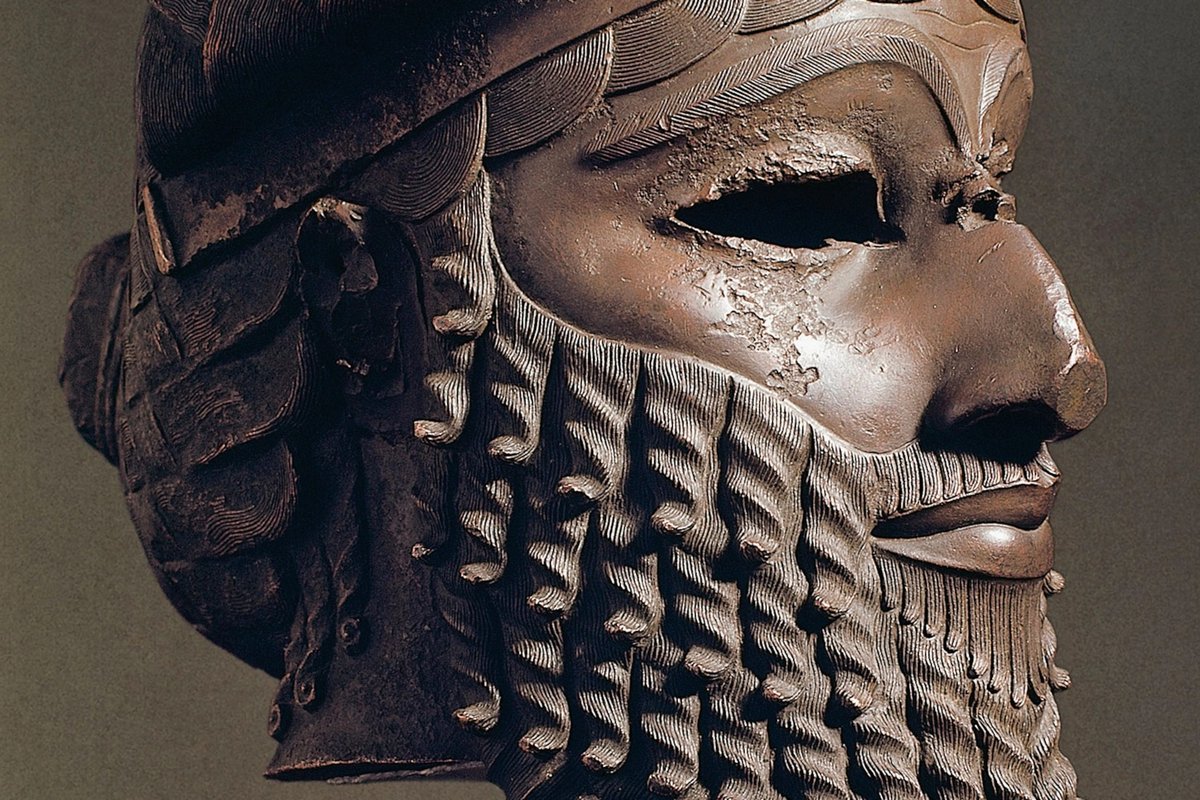
Akkadian art began to distinguish itself from earlier Sumerian styles. There was a notable shift towards realism, particularly in the depiction of rulers and gods. Think of the famous bronze head of an Akkadian ruler (often attributed to Sargon himself or his grandson Naram-Sin), with its intricate beard and commanding gaze – a testament to a new artistic confidence and a focus on individual power and presence. Temples continued to be important centers, but they also served as administrative hubs, integrating religious and secular authority.
Religious Integration: A Unified Pantheon
While local deities remained important, Sargon's empire promoted a more centralized religious pantheon. Worship of powerful deities like Enlil (god of wind, air, earth, and storms) and Ishtar (goddess of love, war, and fertility) gained prominence across the empire, helping to create a shared cultural and religious identity.
Enheduanna: A Daughter's Influence
Perhaps one of the most remarkable figures of Sargon's era was his daughter, Enheduanna. She served for 40 years as the high priestess of Inanna (Ishtar) in Ur, one of Sumer's most sacred cities. Her role was not merely ceremonial; she wielded significant religious and political influence, helping to integrate Sumerian and Akkadian religious practices and traditions. She is also considered by many to be the world's first author known by name, composing powerful hymns and prayers that fused Sumerian and Akkadian religious thought.
Sargon's Echo: The Enduring Legacy of the Akkadian Empire
The Akkadian Empire, under Sargon's dynasty, ruled for approximately 150 years. While it eventually succumbed to internal strife and external pressures (including, famously, the Gutians), its impact was indelible.
Sargon's centralized government, innovative military strategies, sophisticated administrative structures (complete with provincial governors and tax systems), and groundbreaking urban planning served as a foundational model for virtually every subsequent empire in the ancient world, most notably the Babylonian and Assyrian empires. They looked to Akkad's achievements as a blueprint for governing vast territories.
Sargon himself transcended history to become a legendary figure. His name and exploits were celebrated in mythological narratives and literature for centuries, inspiring rulers from Cyrus the Great of Persia to Alexander the Great of Macedon, who reportedly studied Sargon's campaigns. His ability to unite disparate peoples, establish a lasting governmental framework, and connect vast regions into a single economic and cultural entity solidified his place as one of history's most pivotal figures.
Frequently Asked Questions About Sargon and Akkad
How did Sargon the Great die?
Sargon the Great reportedly died of natural causes and old age, after a long and successful reign of 55 years. Unlike many powerful rulers of his era, his demise was not attributed to battle or assassination, further adding to his legendary status as a ruler who brought stability.
What was the main language of the Akkadian Empire?
The main administrative language of the Akkadian Empire was Akkadian, a Semitic language. While Sumerian continued to be spoken, especially in the southern regions, Akkadian became dominant for official records, legal documents, and imperial communication, utilizing an adapted form of the cuneiform script.
What caused the fall of the Akkadian Empire?
The Akkadian Empire eventually declined due to a combination of factors, including internal rebellions from conquered city-states, administrative overstretch, and repeated invasions from nomadic peoples like the Gutians from the Zagros Mountains. Climate change and widespread drought may also have played a significant role in weakening the empire's agricultural base.
What were some key innovations of the Akkadian Empire?
Beyond simply uniting diverse regions, the Akkadian Empire introduced a centralized bureaucracy, standardized weights, measures, and a calendar system, developed a robust postal service, adapted cuneiform for the Akkadian language, and fostered a significant shift towards realism in art. These were groundbreaking administrative and cultural advancements.
What Sargon's Empire Teaches Us Today
The story of the Akkadian Empire and Sargon the Great isn't just ancient history; it's a profound lesson in leadership, innovation, and the enduring challenges of governance.
From Sargon, we learn about the immense power of vision and ambition – to see a fragmented world and imagine a unified one. We see the critical importance of not just military might, but also shrewd diplomacy and a deep understanding of infrastructure and administration. His creation of a centralized bureaucracy, standardized systems, and efficient communication networks highlights principles that remain fundamental to modern nation-states and corporations alike.
His legacy is a reminder that the "firsts" in history often lay the groundwork for everything that follows. The challenges Sargon faced – integrating diverse cultures, maintaining order over vast distances, and ensuring economic stability – are echoes of issues leaders grapple with even today. The Akkadian Empire proved that large-scale, centralized governance was possible, forever changing the trajectory of human civilization and setting a precedent for every empire, kingdom, and republic that has risen since.